The Four Forces of The Modern CPO (Chief People Officer)

Updated: Aug 17
The role of the Chief People Officer has remained curiously ambiguous. Even the job title is contested. CPOs are sometimes referred to as CHROs, or Chief Human Resources Officers; or otherwise perceived to occupy the same role as Heads of Human Resources and Human Resources Directors; or even mistaken for Chief Productivity or Privacy Officers depending on the sector.
This ambiguity has partially obscured the extent of development that the role of the CPO has undergone over the last decade. There is no singular catalyst for this rapid development. The 2010s saw an increasing awareness amongst employees of their rights, emphasised by new generations joining the workforce; an increasing focus on workplace well-being and culture; and employer recognition of the impact these shifts had on attracting and retaining talent.
The COVID-19 pandemic and the recent fast-paced implementation of AI currently occurring in workplaces across the globe have illuminated the organisational benefits of clearer and more centralised people management strategies, as defined and led by talented CPOs.
In order to contextualise the changing role of the CPO, we look at the role across its four main areas of remit – The Four Forces of the modern CPO:
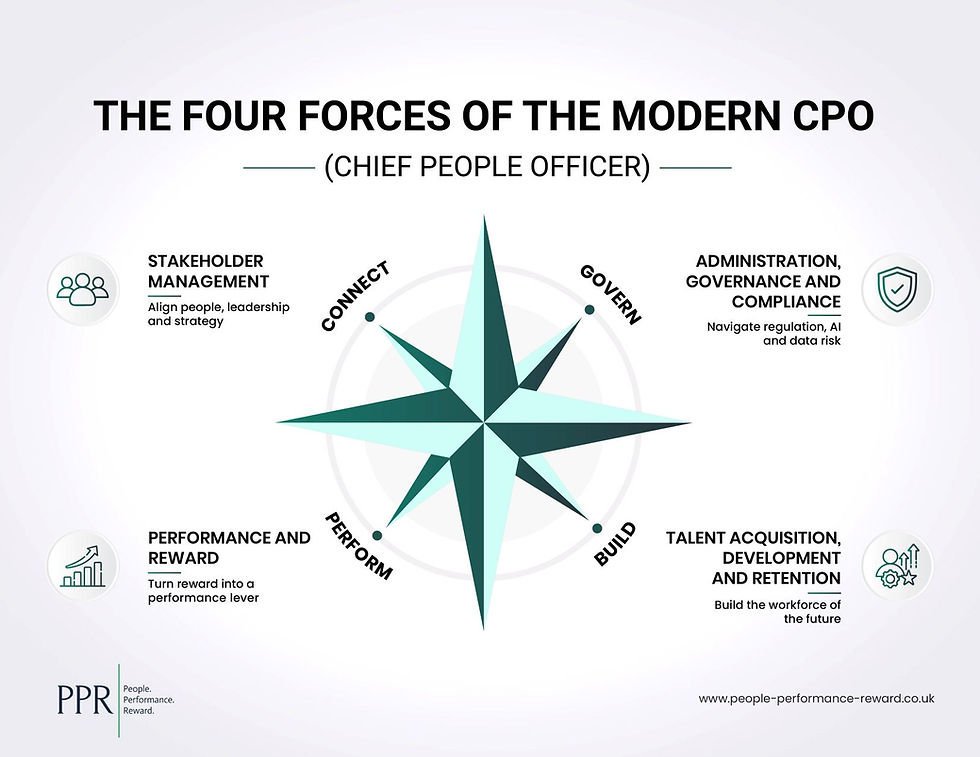
Force 1: GOVERN
Administration, Governance, and Compliance
The implementation of Generative and Agentic AI software in the workplace has been unprecedented in its rapidity. New legislation cannot be drafted or enacted quickly enough to keep up, leaving organisations at a loss to what compliance and best practice actually look like. Specifically, AI’s impact on data privacy is an area fraught with potential pitfalls for which clear guidelines do not yet exist.
It is this example that perhaps best illustrates both the complicated balancing act and the potential for significant impact inherent to the role of the CPO. They are expected to field both the pressure to remain competitive through swift implementation of new technology and the need to ensure compliance and safeguard employee well-being.
However, this is by no means the only area in which CPOs must mitigate potential sources of conflict between organisational objectives. Governance and compliance regarding rewards, remuneration, and pay structures commands more attention than ever before. In several cases, as demonstrated by the EU Pay Transparency Directive, what was previously considered best practice is now law, and organisations must adjust their operations accordingly.
Having comprehensive knowledge of workforce data, identifying areas of concern, planning remedial strategies, and monitoring outcomes has become a key facet of the CPO’s remit, enabling companies to streamline performance management and boost talent retention and compliance simultaneously.
The extent to which this is impacted by a workforce with increasing awareness of their rights is noteworthy, and crucially explains why it is the CPO whose role has expanded to encompass this, blending strategy with a people-first approach.
This blend is also essential to the development of successful DEI strategies, where the curation of a truly inclusive workplace requires a CPO’s deep awareness of company culture and their influence as part of the C-suite.
Equally, succession planning, which seems increasingly unstable in a world where replacing entry-level roles with AI is set to undercut the development of future leaders, demands data-based analysis, creative vision, and a thorough understanding of talent and potential.
Force 2: BUILD
Talent Acquisition, Development and Retention
(Employer of Choice in an Industry)
Arguably the chief impact a CPO can have upon every facet of an organisation is through the attraction, development, and retention of talent.
The competition for talent is getting fiercer as workers become more unwilling to leave their current positions due to unstable job markets; as sectors expand and new territories start to compete; and as the demand for workers with specific skills, particularly in AI, outstrips supply.
CPOs define and manage hiring processes using their knowledge of the hiring market to align the organisation’s needs with prospective employees’ wants. Once again, competition comes into conflict with compliance, with recent legislation across the UK and EU focusing on transparent hiring practices whilst the US steams ahead, able to offer larger salaries and larger bonuses with less oversight.
A good CPO knows exactly which aspects to emphasise to make their organisation attractive to talent, is flexible and open-minded without compromising on non-negotiable requirements, and centres compliance throughout the hiring process. This also involves keeping a keen eye on company reputation and engaging strategies for reputation management where necessary.
Such strategies can be dependent on developing and retaining talent.
CPOs can maximise their impact by creating opportunities for professional development that align with organisational goals. Employees who are supported, invested in, and aware that their value to the company is appreciated contribute to a positive workplace culture and are more likely to remain engaged.
How this engagement is monitored is the responsibility of the CPO. Defining engagement and the metrics used to assess it can be territory, sector, and even company-specific, requiring a clear and consistent vision in order to benefit from it.
With organisations increasingly pivoting towards “people-focused” or “people-first” strategies, the CPO is an increasingly visible member of the C-suite, one who can successfully bridge the gap between the C-suite and employees by applying their knowledge of employee engagement.
Force 3: PERFORM
Performance and Reward
Pay, incentives and benefits bring together the worlds of HR, Finance and the Operations. Today the People function is typically expected to be both a custodian of and a subject matter expert in this domain.
Measurable business outcomes are a product of the intertwined and interdependent nature of these worlds, occurring when the strategic priorities of the organisation are aligned with the incentives offered to employees.
What a CPO understands best of any member of the C-suite is that competitive advantage and strong financial outcomes are the direct result of workforce capability. In turn, it is adaptive, objective-driven workforce management strategies led by the CPO that develop this capability.
At the centre of this is the rewards strategy. Alongside the aforementioned opportunities for professional development, total rewards offerings comprise fixed compensation, incentives and variable compensation, benefits, commission structures, and recognition.1
CPOs can ensure, through a combination of considered modelling, responsive management, and judicious engagement with technologies like AI, that the rewards strategy is both consistent and transparent. This in turn guarantees compliance, but also influences workplace culture, building trust with employees and stakeholders alike and supporting organisational resilience.
Force 4: CONNECT
Stakeholder Management
A CPO’s ability to handle any arising tensions between employee expectations, stakeholder expectations, and organisational realities constitutes another factor in the role’s rapid rise during the past decade. The highly-developed soft skills integral to the role of CPO have influenced attitudes towards the importance of soft skills in the C-suite more generally.
This has been reinforced by the increasing number of former CPOs or HR Directors being appointed to the role of CEO, as well as new generations designating good people management as the cornerstone of good organisation management.
One aspect of this is the CPOs inclusion in devising, initiating, and executing organisational-wide transformation. As mentioned already, CPOs’ involvement with succession planning, a key facet of both talent management and transformation, is extensive.
The way in which succession planning influences the shape, management, and direction of a company for generations to come makes the CPO one of the most important contributors to any forward-thinking organisation. A CPO must identify critical roles, spot and cultivate potential, set up systems to support both upward and lateral transitions, and intimately understand both the current and future requirements of the organisation.
An evolving role of a good CPO is also good internal stakeholder management, including for the CEO and other C-suite, to improve the overall cohesion and the effectiveness of the organisation’s leadership team.
Conclusions
Adaptation, Impact, and Rising CPO Pay
Ultimately, the ambiguity attached to the role of the CPO over the last decade is one of the main strengths of the role — a good CPO adapts to the needs of the market and then to the needs of their individual organisation, they bridge gaps between the C-suite, other stakeholders, and the wider employee base, and they offer solutions that are at once strategic and people-centred.
They add value through their direct contributions to governance and compliance; the attraction, development, and retention of talent; development of rewards strategies; and stakeholder management, facilitating organisational objectives without sidelining stability, cohesion, and culture.
The changes that the role of the CPO has undergone are the changes that the modern workplace has demanded. The impact that CPOs now have is a testament to the success of this rapid adaptation and subsequent recognition of their significance to the C-suite.
The rise in average CPO pay recognises this, having increased by approximately 14% in the past three years, compared to a 9% increase in the average pay of all other executives during the same period.

CPO salaries are now ‘on parity with other leaders in the business’, and the majority of HR department budgets have remained steady or increased from 2025 into 2026 despite the proliferation of external economic pressures and instability.
The increase in financial value allocated to the role of the CPO is distinct and unambiguous: it is as simple as an increase in pay to account for an increase in impact and relevance. However, what this in itself can tell us about the development of the role of the CPO, how it is perceived and valued, and how it will change in the near future, extends beyond what can be numerically assessed.
What we can be certain of is that the role of the CPO will continue to expand and adapt to new challenges, and that it is currently one of the most integral roles needed to ensure dynamic organisational transformation.
1 Recognition is defined by the CIPD as ‘personal non-monetary rewards given to employees to acknowledge and reinforce their efforts, behaviour or achievements’.