Aligning Communication & Recruitment with the EU Pay Transparency Directive — A Guide for HR Leaders

Updated: Mar 31

The EU Pay Transparency Directive aims to ‘strengthen the application of the principle of equal pay for equal work or work of equal value between men and women’. But what does implementing this look like within the workplace, and how will this change the recruitment process?
Communication:
Building a Comprehensive Plan in Five Core Steps
Whilst compliance with new transparency legislation is the central concern of most organisations, employers that focus solely on compliance will find effectively communicating the meaning behind their changes to employees a challenge. Genuine support for the principles of pay equity extends beyond legal compliance, and should be embedded into the fabric of an organisation to ensure lasting positive impact.
Developing a successful implementation and communication strategy will depend on several factors including the size and complexity of the organisation, the maturity of the existing job architecture and reward policy framework, and the current level of transparency afforded to employees. However, the key steps remain the same:
Define ‘workers’ - the Directive’s definition of ‘worker’ is wide-ranging, covering every type of employee that fulfills the given criteria, from apprentices to intermittent workers. Employers must define and categorise their employees accordingly, using the criteria provided in the Directive.
Evaluate work of equal value - employers should develop objective, gender-neutral criteria relevant to their organisation, then use this criteria to compare the roles of workers in each category and assess which are equivalent. For roles that are not equivalent, employers need to be able to justify what differentiates them in clear, consistent terms that reference their criteria. These justifications should be shareable with employees.
Gather pay data - employers should conduct an equal pay audit or otherwise compile the latest pay data from across their organisation. This data should be grouped based on the categories developed in step one. Any disparities should then be identified, and strategies to address them should be developed ahead of the introduction of mandatory reporting.
Identify stakeholder groups - employers must identify who they need to share their data with. Following the instructions for mandatory reporting laid out in the Directive will ensure compliance, but many organisations will find they have to provide more information to stakeholders to explain any major changes. This will include identifying which pay information is relevant to each stakeholder group, and what can appropriately be shared.
Train and empower managers to be confident in supporting the process and in dealing with questions from their reports.
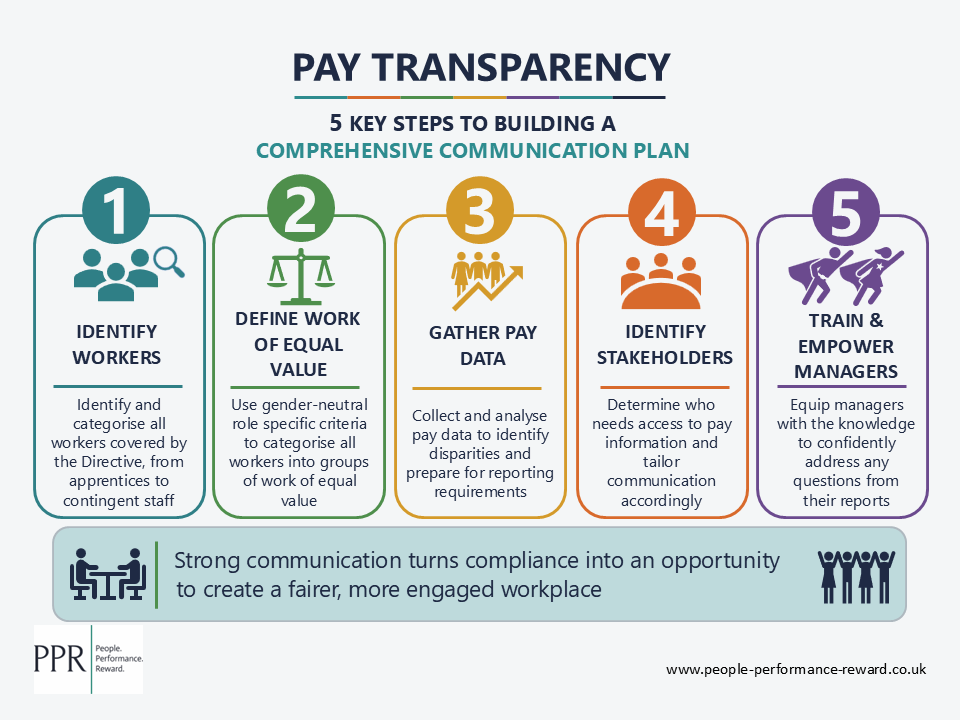
These five steps should provide sufficient information to develop a comprehensive communication plan. Data privacy should be a key consideration throughout this process. In addition, data accuracy and ensuring that data is contextualised effectively are essential to building trust and preventing misunderstanding and resentment once information is made available. If an employer needs to update their job architecture, employees should be informed as early in the process as possible. They should state the reasons for the updates and be clear about intentions and outcomes. Consistent messaging is essential, so it will be imperative that managers are trained and that management onboarding procedures are updated to include the new information.
Once pay data is published, employees will ask questions. Employers must ensure that managers are prepared to answer them consistently and justifications for any differences in pay must be made readily available. To avoid tensions, the communication plan should not be built with defense in mind, instead employers should focus on inclusivity, honesty, and sensitivity to the cultural shift that increased transparency will initiate.
Recruitment: Building a Transparent and Inclusive Hiring Process
Implementing the EU Pay Transparency Directive will have a significant impact on the recruiting process.
Whilst not bound by the Directive, the UK Government has recently published guidance on how to update job descriptions to make them inclusive. It advises employers to remove ‘words typically associated with gender stereotypes’, utilise a ‘standard inclusive language checklist’ to review every draft to ensure consistency and neutrality, and to outline requirements with ‘behaviour-based criteria’ instead of desired character traits.1 Given that the Directive itself does not explicitly cover adapting job descriptions, guidance will differ between Member States, so employers should establish a consistent framework that aligns with both national law and the aims of the Directive to ensure compliance.
Employers must also include more detailed information about pay during the hiring process; pay ranges must be provided in the job description and any subsequent information about pay must be provided in good time ahead of any negotiations about pay.2 Employers may still ask candidates what their salary expectations are during the interview process, but they cannot base this upon or ask about the candidate’s previous or current remuneration. This change intends to prevent the perpetuation of discrimination; for example, if a female candidate is subject to discriminatory pay practices in her current role, and a potential new employer asks her about her salary expectations based on her current remuneration, then this risks carrying the impact of discriminatory pay practices forward.
Whilst some organisations may be concerned about the impact that pay transparency could have on their ability to be competitive, increased transparency during recruitment will attract talent. Inclusive job descriptions draw in wider pools of applicants, making it more likely that employers will find a candidate that suits their needs. More broadly, greater transparency within an organisation can improve employee engagement and productivity by fostering a culture of trust and openness, thus boosting employee retention and securing better business outcomes.
For a conversation on how these principles can be tailored to your organisation’s preparation, our Principal Consultant, Paul Hunter, would welcome the opportunity to connect. You can reach him at paul@people-performance-reward.co.uk
1 The example given here is to use ‘you keep confidential information to yourself’ instead of ‘you are reliable’.
2 See clause 32 of the EU Pay Transparency Directive.
Selected Bibliography
Creighton, Kelly, ‘4 Reasons You Need a Transparent Company Culture’, HR Daily Advisor, 29 March 2019
‘Directive (EU) 2023/970 of the European Parliament and of the Council of 10 May 2023 to strengthen the application of the principle of equal pay for equal work or work of equal value between men and women through pay transparency and enforcement mechanisms’, European Union, 10 May 2023
Hunter, Paul, ‘EU Pay Transparency – How Should Organisations Be Preparing?’, People. Performance. Reward., 21 July 2025
King, Charissa, ‘The UK leads on pay transparency, data suggests’, HR Magazine, 12 February 2025
‘Make job descriptions inclusive’, Office for Equality and Opportunity, Government of the United Kingdom, 4 March 2026
‘Mesures et engagements en faveur de l’égalité professionnelle entre les femmes et les hommes’, Ministères Économiques et Financiers, 5 September 2025
‘What is special category data?’, Information Commissioner’s Office, 9 April 2024