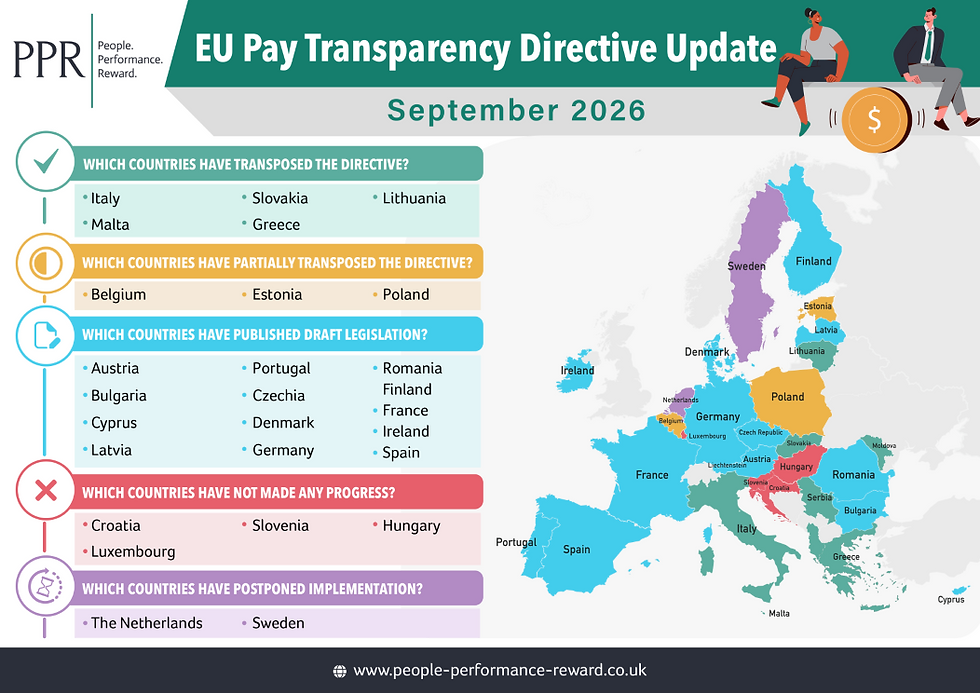
Pay Equity in Practice: The EU Pay Transparency Directive

According to the Office for National Statistics, the gender pay gap in the UK stands at 6.9% (as of April 2025).1 It has been decreasing steadily, having fallen by more than a quarter over the last decade. However, men still earn more than women in full-time employment across all occupation groups. The gender pay gap in the EU was 11.1% in 2024, but this varies significantly between individual Member States (highest gap: Estonia, 18.8%; lowest gap: Luxembourg, -0.8%). In both cases, these figures do not represent the difference in pay between men and women for doing the same job or ‘work of equal value’, but instead represent measurements taken simply across all jobs. This is the issue facing many organisations as the June 2026 deadline for the EU Pay Transparency Directive approaches.
The key question being asked is “What is work of equal value?” How should organisations be preparing to measure it? And what are the risks if they fail to do so? We discussed the initial readiness steps organisations should consider in our earlier article: EU Pay Transparency – How Should Organisations Be Preparing?
Defining Work of Equal Value
The Directive establishes how equal pay is currently hindered by ‘a lack of transparency in pay systems, a lack of legal certainty on the concept of work of equal value, and by procedural obstacles faced by victims of discrimination’. Employers must ensure they have pay structures in place that account for ‘comparison of the value of different jobs within the same organisational structure, and that to do this, organisations must be able to confidently define and assess work of equal value. In Article 4, the Directive specifies that the objective criteria necessary for this assessment include the following four factors:
1. Skills
2. Effort
3. Responsibility
4. Working conditions.2
However, it is up to individual Member States to provide the accessible guidance and tools necessary to facilitate this. Proving work of equal value relies on suitable comparison, which also provides a challenge for employers.3
Evaluating Work of Equal Value in Practice

The Equality and Human Rights Commission defines ‘like work’ as ‘work that is the same or broadly similar’ with tasks that require similar knowledge and skills, where differences are not of ‘practical importance’. This differs to ‘work rated as equivalent’, which defines work that has been found to be ‘of equal value in terms of how demanding it is, including effort, skill and decision making’ through a formal evaluation or assessment process. ‘Work of equal value’ is defined by equality in terms of demands, but often compares work that does not involve similar tasks.
To remain compliant with the new Directive, employers with at least 100 workers (initially) will be expected to report regularly on pay and ensure that this information is published publicly. This will involve employers determining what ‘work of equal value’ is within their organisation, assessing what category of worker each of their employees belongs to using appropriate gender-neutral criteria, and ensuring that they are gathering the data specified in Article 9 of the Directive. Many employers will be familiar with these processes to some extent, however, the necessity to bring existing procedures in line with the Directive could cause confusion and intensify administrative burden. For example, gender pay gap reporting has been mandatory for organisations of 250 or more employees in Ireland since 2022.4 However, current legislation only requires employers to break pay down by gender in their reports, and not by category of worker, which means that Irish employers will have to make significant updates to their existing procedures.
Identifying and Justifying Pay Differences
If pay reporting reveals a difference of 5% or more between male and female workers within a given category, then the employer must assess if this is justified using gender-neutral criteria.
Guidance on what justifications will be accepted has not been forthcoming, and will be left to individual Member States to provide, but ACAS provides several examples of where a difference in pay might be permissible. This could include if the comparative employee is better qualified or has skills that are harder to recruit; if they work at a branch of the company in a different location (such as London, where living costs are higher); or if they work different shifts and a valid reason is given as to why one shift should be paid more.
Where a justification cannot be provided, or where the discrepancy in pay has not been remedied within six months, then a joint pay assessment should be carried out.
What is a Joint Pay Assessment?
Joint pay assessments, detailed in Article 10 of Directive, should provide comprehensive information on the pay of female and male workers, broken down by category, complete with a record of the proportion of female and male workers in each category. Reasons for the difference in average pay levels, if any are available, should also be included, as well as the measures that will be implemented to address the differences. The joint pay assessment should be made freely available to workers and workers’ representatives, and Member States must ensure that there is an appropriate monitoring body for the assessment to be forwarded to.
To prepare for their new obligations, employers should review what action they have undertaken to prevent unjustified pay differences, as well as what reporting mechanisms they have in place to monitor this.
Building the Foundations:
The Importance of a Solid Job Architecture
To be able to practically define work of equal value and at scale, organisations will require a solid job architecture built around two key principles:
A recognized Job Evaluation methodology to be able to grade work
Job family development that groups together jobs with a similar background and skillset
Transparent, robust job architecture can provide everyone within an organisation, from management to HR to all individual employees, with a shared understanding of the levels of work with the organisation.
To prepare for the implementation of the EU Pay Transparency Directive, organisations should review their job architecture. Will your job families allow you to effectively categorise workers? Are your job grades justifiable? Are your job descriptions consistent? Is the hierarchy of job positions clear to everyone within the organisation?
The EU Pay Transparency Directive will require organisations to move beyond reporting gender pay gaps and towards demonstrating that pay structures are fair and justifiable. Central to this is the ability to define and assess “work of equal value” using objective, gender-neutral criteria.
For many organisations, compliance will depend on having robust internal frameworks in place to evaluate roles, categorise workers consistently, and identify unjustified pay differences. Reviewing existing job architecture, evaluation methodologies, and reporting processes will therefore be an important step in preparing for the Directive and ensuring that pay practices are fair, transparent and defendable.
If you would like further guidance on preparing for the EU Pay Transparency Directive or reviewing your organisation’s pay structures, please get in touch with our Principal Consultant, Paul Hunter at paul@people-performance-reward.co.uk to explore how we can support you.
1 Here, the gender pay gap is defined as ‘the difference between median hourly earnings (excluding overtime) of men and women, as a proportion of men's median hourly earnings (excluding overtime)’.
2 Please see clauses 11, 12, 26, 28, and 31 in Directive (EU) 2023/970.
3 Please see Article 19 in Directive (EU) 2023/970.
4 This became mandatory for organisations of 150 or more employees in 2024, and for organisations of 50 or more employees in 2025.
Selected Bibliography
‘Directive (EU) 2023/970 of the European Parliament and of the Council of 10 May 2023 to strengthen the application of the principle of equal pay for equal work or work of equal value between men and women through pay transparency and enforcement mechanisms’, European Union, 10 May 2023
‘Equal pay and the law’, ACAS, 7 November 2024
‘Equal work’, Equality and Human Rights Commission, 26 August 2020
‘Gender Pay Gap Information Act 2021’, Irish Statute Book, 13 July 2021
‘Gender pay gap in the UK: 2025’, Office for National Statistics, 23 October 2025
‘Gender pay gap statistics’, Eurostat, February 2026
Hunter, Paul, ‘EU Pay Transparency – How Should Organisations Be Preparing?’, People. Performance. Reward., 21 July 2025