AI is Changing the Face of Reward

Artificial intelligence is changing the face of reward within organisations. In particular, AI is enabling organisations to make more informed, data-driven decisions, making reward programmes more effective than ever.
Whilst the adoption and integration of AI remains uneven across sectors, organisations, and even generations, the direction of increased adoption is clear. Many organisations are still primarily using AI for administrative efficiency in reward and compensation, but its potential is far greater. Businesses that invest in and integrate AI into their teams are better positioned to exploit the large data analysis functionality within AI to enhance reward programmes and business outcomes.
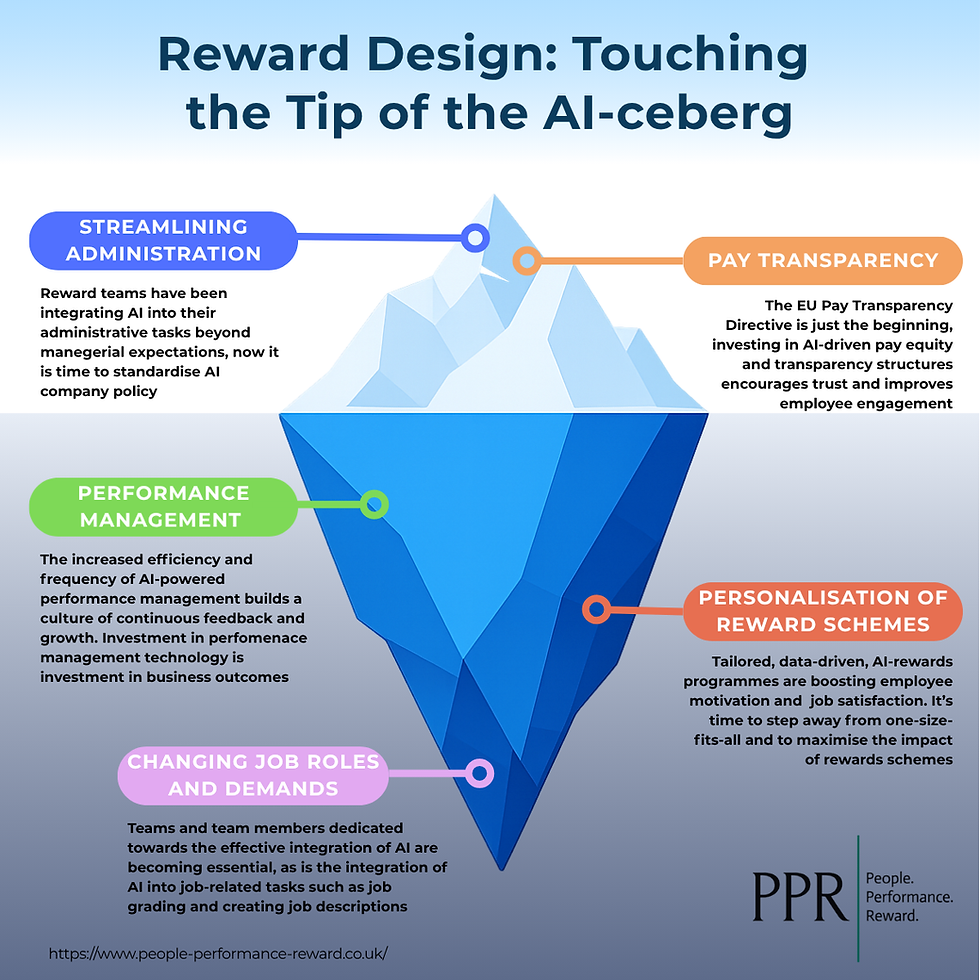
Pay Transparency and Equity
Pay transparency is becoming increasingly essential in compensation design, with the 2026 EU Pay Transparency Directive offering a new legislative benchmark for company policy. Whilst businesses self-report optimistic levels of preparation to meet the June 2026 pay transparency deadline, far fewer companies report that they are already in a position to do so.
AI enables quicker and more comprehensive analysis of compensation data and can identify disparities and support consistent, evidence-based reporting. Whilst pay transparency has often been treated as a legal compliance task, AI facilitates a greater emphasis on the relationship between pay transparency, employee engagement, and market competitiveness.
Performance Management and Reward
Effective performance management systems are the critical link between incentive rewards and business outcomes. The adoption of generative AI’s data-processing power is ensuring that traditional review cycles are giving way to more frequent and dynamic, data-driven approaches.
AI measurably benefits performance management processes by implementing a culture of continuous feedback and growth. By aggregating real-time performance data and providing more frequent feedback, AI clearly illustrates the direct relationship between reward and employee contributions, allowing employees to work more effectively towards business goals. The systematic approach of AI-driven performance management also supports consistent evaluation across the workforce, helping to reduce company-wide inequalities and the margin of error associated with subjective performance interpretations.
Personalisation of Reward Schemes
One of the most significant shifts enabled by AI is the move away from traditional one-size-fits-all reward schemes toward personalised incentives. Employees increasingly expect offerings that reflect their individual needs, whether that is flexible working, wellbeing support, or other benefits.
The Incentive Research Foundation (IRF) highlights the potential of AI to make such personalisation practical through the analysis of demographic, behavioural and performance data. Generative AI can then recommend reward packages which maximise perceived value for employees whilst maintaining cost efficiency for employers.
Boosting Motivation and Satisfaction
The measurable effects of increased reward personalisation are clear: personalised and transparent reward systems directly impact employee engagement, confidence, and trust. A study published in the International Journal of Management Research and Emerging Sciences found that AI can effectively incorporate complex workplace diversity into personalised reward recommendations, thereby boosting motivation, satisfaction, and retention. Rezha Adityaksa’s 2025 investigation into AI integration found measurable increases in employee engagement and trust, when employees understand and value their incentive programmes, satisfaction and motivation tend to increase.
Relieving Administrative Burden
The localised use of AI within organisations has already been more widespread than employers have perceived, according to McKinsey’s ‘Superagency in the Workplace’ report. Administrative reporting, communications, and data analysis can be significantly offloaded, allowing for employee time to be more effectively dedicated towards human-centred projects such as building client relationships and evaluating complex AI-generated proposals.
The McKinsey report also highlights an uneven embrace of AI within organisations across generational gaps, and indicates much more employee readiness for the further integration of AI than employers predicted. As such, the next steps in the integration of AI into reward administration are incentivising its adoption, providing relevant training opportunities, and offering standardised AI practices which address ethical and privacy concerns.
New Job Roles, New Job Demands
AI is transforming the job architecture that underpins reward teams through both the types of roles organisations need and how those roles are defined and evaluated.
Firstly, new AI-related roles are emerging across data, technology, and policy. Reward teams must integrate these new roles into existing compensation structures and ensure that incentives remain competitive in this fast-changing job landscape.
Secondly, AI is enhancing essential job-related administrative tasks by making them more consistent and evidence-based. Tasks such as drafting job descriptions and determining job grades are becoming increasingly supported by AI-driven market analysis.
The Hesitations
The privacy, accuracy, and reliability limitations of generative AI ensure that human oversight remains essential in the technological development of reward systems, requiring AI to be integrated as a suggestion-generating tool, not a decision-maker.
Alongside McKinsey’s findings of unprecedented employee readiness for AI integration, the IRF survey identified the employee concerns which must be addressed in order to continue. Privacy concerns necessitate investment in secure AI models which protect client and company data. Generative AI analysis is only as valuable as the data it is fed (which often is neither complete nor accurate); the risks of extrapolating data bias necessitate rigorous data collection methodologies and ongoing oversight in order to minimise risk and maintain ethical standards.
The Future of Reward
The face of reward is rapidly changing.
As AI becomes more embedded, reward will shift away from static programmes to dynamic systems which continuously adapt to performance, employee needs, and business objectives.
Reward is not just a mechanism for compensation, but a strategic tool for shaping behaviour, culture, and growth. Whilst the human aspect of compensation planning remains critical in ensuring that the integration of AI-driven systems remains fair, trusted, and meaningful, AI technology is revolutionising the processing power and breadth of insight available to reward teams.
Selected Bibliography
‘AI: Uses And Possibilities For Incentives Professionals’, Incentive Research Foundation, 23 April 2024
‘AI-based Reward System and Job Satisfaction: The Mediating role of Motivation’, International Journal of Management Research and Emerging Sciences, September 2025
‘The Impact of AI Adoption on Job Engagement and Employee Trust’, Golden Ratio of Human Research Management, Rezha Adityaksa, January 2025
‘Superagency in the workplace: Empowering people to unlock AI’s full potential’, McKinsey & Company, 28 January 2025