Designing Reward for Performance, Retention and Value Creation

Historical Context
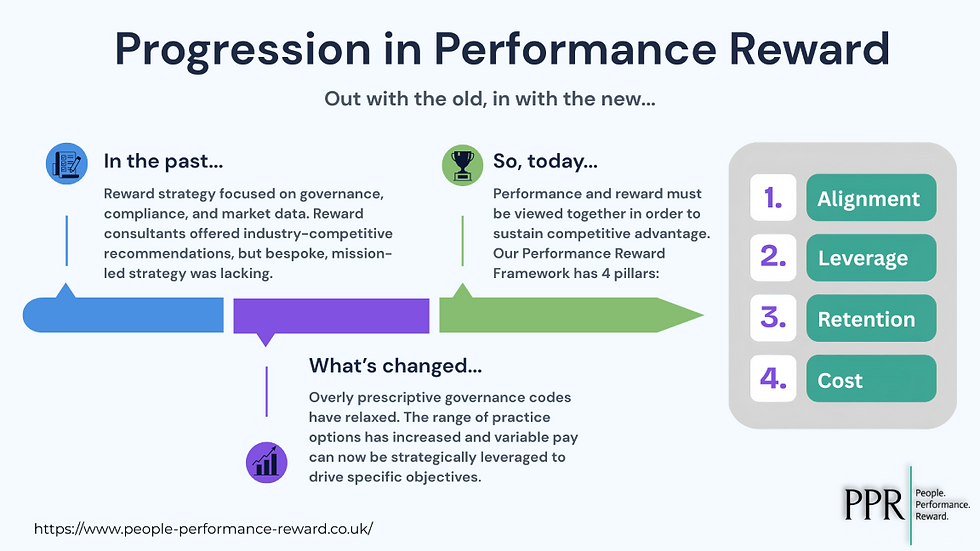
For the recent past reward functions and Remuneration Committees have been very heavily focussed on governance and compliance.
Reward consultants assisted by having a good understanding of governance codes and large data sets. They could tell clients that a certain percentage of the market was doing X and another percentage was doing Y, but not much more.
This made it difficult for organisations to know exactly what they should do in terms of a bespoke reward strategy to actively support their business in it’s growth ambitions.
A New Landscape for Reward
Overly prescriptive governance codes have had unintended consequences and have been adjusted or relaxed, for example in Financial Services where bonuses were limited, the industry saw abnormal growth in fixed pay as the market adjusted to ensure that total pay remained competitive.
Remco’s and reward functions have more discretion and the range of practice options has increased. Reward now needs to be able to deliver a differentiate reward offering that helps to drive enterprise value growth and other strategic objectives.
Our Strategic Performance Reward Framework for Value Creation
To be able to deliver a differentiated reward offering that provides a competitive advantage, performance and reward must be viewed together.
Our Framework has 4 pillars:
Alignment – Reward must align managers and colleagues with organisational growth ambitions. This includes ensuring that the right organisational, team and individual financial and non-financial performance measures are selected and that performance improvement targets are set that support the organisation’s growth ambition within the industry context
Leverage – The reward framework must provide the right amount of leverage or pay at risk to encourage the hard work and tough decisions needed to create value. The pay mix must ensure that risk is shared appropriately at different levels in the organisation (variable pay in it’s most basic form is a sharing of risk around business outcomes between shareholders and employees)
Retention - The reward offering must have the right pay levels and mix to enable the organisation to be able to recruit and retain the talent needed
Cost – The objectives of alignment, leverage and retention must be achieved at a competitive cost to the organisation. Sensible pay positioning combined with accurate role sizing and benchmarking are key components of sensible reward cost (and pay equity) management. Incentive compensation plans should always be self-funding if properly designed.

The organisations that outperform their peers will be those that use reward strategically, not administratively. By focusing on alignment, leverage, retention and cost, reward can become a catalyst for long-term value creation.