The RemCo and CPO: Creating Impact Beyond Executive Reward

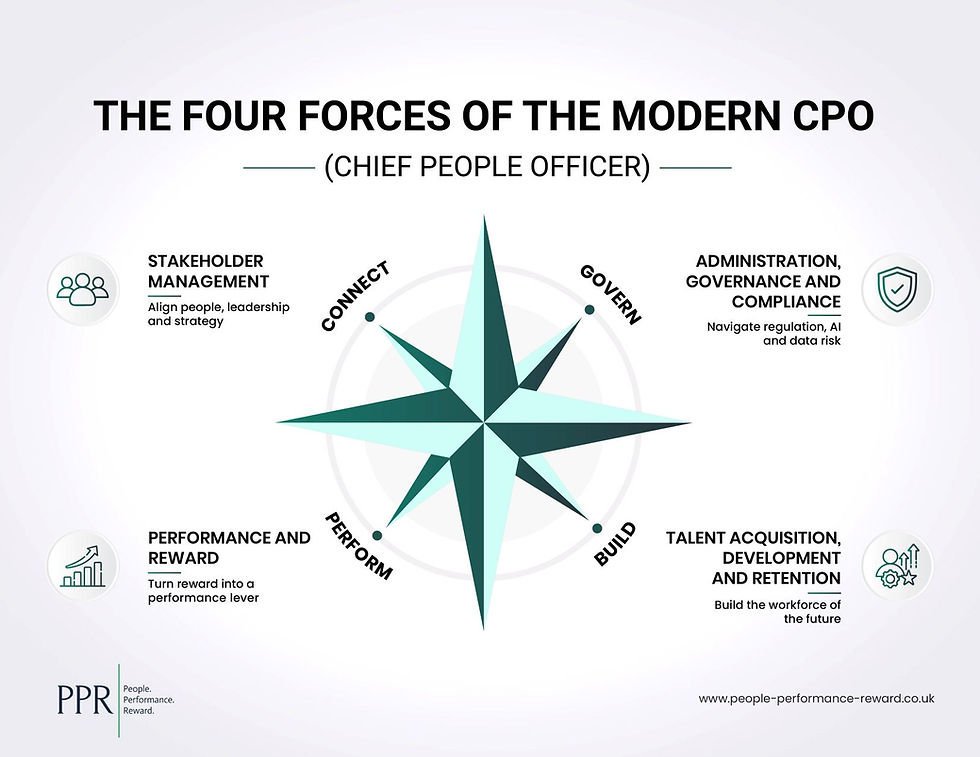
Whilst the Remuneration Committee leads on governance and remuneration arrangements for the Executives, the Chief People Officer must facilitate a seamless application of rewards philosophy and policy that spans the entire organisation. The relationship between the CPO and the RemCo must therefore be robust and highly collaborative for an organisation to function successfully.
It is also true that the role of the CPO is expanding and that the RemCo is being expected to consider a wider range of factors, both cultural and governance-related, than ever before.
In this article, we examine how the CPO and the RemCo should align, looking at key points of overlap between their remits and suggesting how they can best work together to achieve organisational outcomes.
The CPO: Bridging the Gap Between the RemCo
and the Wider Workforce
The RemCo can sometimes be so focused on their primary function of setting Executive remuneration that it leaves little room to consider the wider workforce. However, any reward policy and framework designed and aimed at Executive level must also apply equally well across the whole workforce.
Ensuring that this organisation-wide application is both succesfull and comprehensive is where the role of the CPO, who acts as a critical point of connection between the RemCo, the C-suite, and all employees, becomes instrumental.
In this respect, the CPO has the opportunity to act as both a bridge between and a representative for each party, promoting the strategic importance of people matters at every level and addressing any perception that the RemCo is ‘elitist or disconnected from the experiences of lower-level staff’.
To contribute further to this, a CPO must be actively aware of environmental or cultural issues impacting the workplace and cultivate a consistent track record of representing these issues at a senior level, including within the RemCo.
This requires a degree of sensitivity, discernment, and cultural literacy that goes beyond simple awareness, traits which an experienced CPO and a well-appointed RemCo must share to ensure organisational cohesion. This is also an important component of organisational reputation, and therefore essential to attracting talent and remaining competitive.
The RemCo: Overcoming Obstacles and
Implementing Change
Changes to the remit of the RemCo are not likely to be made without challenges. There are simple constraints, like the time available to RemCos not being sufficient to deal with the number of complex issues that they are increasingly expected to discuss. Broadening the remit of the RemCo or building out a People and Culture committee that will also consider rewards and pay can be useful methods for addressing these constraints.
Increasing the frequency or duration of RemCo meetings, or else reserving a set amount of time for discussion of rewards and the wider workforce is another potential fix, although it is dependent on several factors, including the availability of RemCo attendees.
Promoting transparency and ensuring better alignment between the RemCo and the rest of the organisation will also help to resolve perceptions of elitism, and easing friction between shareholders, the C-suite, and the wider workforce.

The CPO and the RemCo: an Integral Relationship
Fundamentally, the CPO and RemCo must be able to work together. Lines of communication must be open and secure; remits must be transparent and unambiguous; and accountability must be present and shared.
A good CPO is a valued and integral part of managing performance and reward, and a well-appointed RemCo will both recognise and make use of the CPO’s organisation-focused expertise.
The subsequent strong relationship between the CPO and the RemCo should be able to withstand external and internal pressures and enable both parties to make decisions about pay and rewards that are creative and aligned with strategic aims and employee well-being.
The result of this will be an ongoing, comprehensive, ambitious, and defensible reward philosophy with accompanying governance that can be applied not just at the Executive level, but equally across the whole organisation.