EU Pay Transparency Directive Update September 2026

The EU Pay Transparency Directive was ratified 10 May 2023 and the transposition deadline passed 7 June 2026.
The Directive aims to address the gender pay gap across the EU, which currently stands at around 11%, by enforcing pay transparency and strengthening the principle of equal pay for work of equal value between women and men.
Despite having had three years to prepare, and facing the threat of fines and sanctions by the EU, only four countries met the deadline, and only five countries have transposed it as of 01 September 2026.
Which countries are leading the way and which are falling behind? As part of our ongoing series of articles, People. Performance. Reward. considers the implementation status of the EU Pay Transparency Directive below.
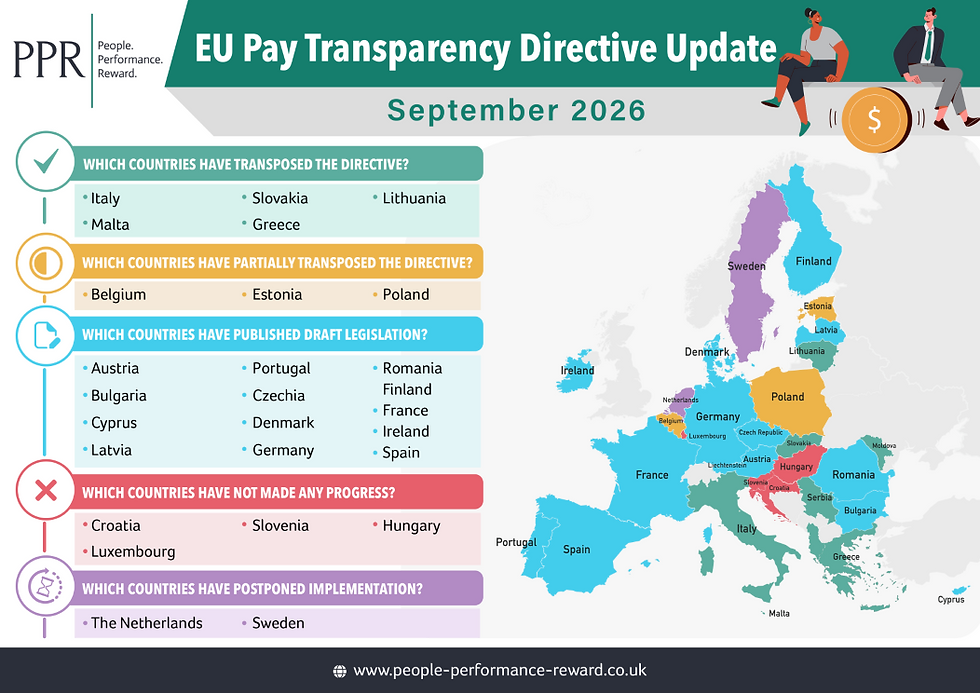
Which countries have transposed the Directive?
Italy, Malta, Lithuania, and Slovakia met the deadline for transposition, with Greece following shortly after.
Slovakia and Italy
The legislation enacted in Slovakia and Italy respectively align broadly with the Directive, with each featuring only a few elements that fall short of or alternatively exceed the Directive’s requirements.
Malta
Malta has transposed the Directive effectively immediately, with organisations expected to prepare to meet obligations without delay. The timeframe imposed on employers who receive pay information requests from their employees is very short, a response must be given within eight days, and Malta has outlined the fines that organisations will be liable to pay should they fail this.
The Maltese legislation invites further questions — employees must provide initial proof of discrimination, and if a Joint Pay Assessment is triggered, Maltese employers must provide satisfactory justification. Who judges what the threshold is regarding this initial proof? And who assesses if a justification is satisfactory; to whom is it required to be satisfactory to — the employee or an external assessment body? For now, answers remain unclear, and other territories yet to publish legislation must watch on in interest.
Lithuania
The extent to which Lithuania has transposed the Directive is somewhat unclear, given the continued existence of prior legislation that already aligned with sections of the Directive, as well as the decision to implement certain aspects on a phased basis, and the reported protestations of employers.
Greece
It is notable that, at the time of our previous implementation status update in February this year, Greece had not taken any publicly announced action towards transposition, making their progress rapid and unexpected.
International organisations with employees in these countries must be prepared to evaluate, define, and defend their definition of work of equal value immediately, but also look ahead to compiling and analysing relevant pay data for reporting next year.
Which countries have partially transposed
the Directive?
Belgium
The progress of the previous frontrunner Belgium has stalled, with disparities in implementation of the Directive between regions and between the private and public sector deepening. The Federal Minister of Employment and the Minister for Equal Opportunities have jointly submitted a letter to the European Commission, requesting a six-month postponement and answers to some 30 additional questions about implementing the Directive. It is unlikely that Belgium will continue to make progress before they receive a satisfactory response to this letter. Other countries may follow suit, or else wait to see how the European Commission responds to Belgium’s requests.
Estonia
Estonia has also partially transposed the Directive as of 13 July 2026, with employers now required ‘to share the salary with candidates before a job interview’ and banned from engaging pay secrecy rules in the workplace. Transposition has not occurred without significant pushback, with the Minister of Foreign Affairs calling the new requirements ideologically-motivated and stifling to businesses, and the Minister of Economic Affairs arguing that it would be simpler to pay fines to the EU than account for the burden of the new legislation.
Despite this, Estonia’s new legislation does not cover pay gap reporting, Joint Pay Assessments, or the rights of workers to request pay information. It is not yet clear if further legislation will be drafted to address these areas.
Poland
By February this year, Poland had already partially transposed the Directive. Additional legislation encompassing further requirements from the Directive is currently making its way through the parliamentary process.
Which countries have published draft legislation?
Several countries have published draft legislation: Austria, Bulgaria, Cyprus, Czechia, Denmark, Finland, France, Ireland, Latvia, Portugal, Romania, and Spain.
Of these, the progress of Cyprus and Finland seems to have stalled based on their expected trajectory from February this year. In Cyprus, a draft bill was released in late 2025, but it has still not been passed. In Finland, the draft proposal has not yet been submitted.
Czechia has made significant progress during August, having published an amendment to the Labour Code and suggested that further legislation is being developed and will likely be implemented on a phased basis between 2027 and 2031.
Romania has also moved incredibly quickly, engaging emergency procedures to register their draft bill with the Senate, receiving and processing feedback, and resubmitting the bill for committee approval, all within the space of twelve days during June. It is likely the bill will be enacted before the end of the year.
Spain’s draft is slightly different, in that it is currently in the form of a draft Royal Decree. The public consultation period for the decree ended 24 August, with further progress subject to the decree being adapted and transposed into a law.
Portugal
Portugal’s draft legislation was released for a brief public consultation period, which ended 25 August. The proposed bill does not go as far as the Directive, as candidates for employment would only have to be provided with salary information before they signed a contract, and not prior to the interview. There is also some disparity regarding timeframes and thresholds, with different reporting deadlines depending on the headcount of the organisation, and more opportunity for employers to justify their practices before a Joint Pay Assessment is triggered.
Ireland
Ireland already has legislation in place obligating employers of 50 employees or more to undertake gender pay gap reporting.
As of July, Ireland is planning to implement new measures on a phased basis, and has no plans to fine organisations for non-compliance until updated legislation is enacted. This was preceded by the launch of public access to the Gender Pay Gap Portal, which had been accessible to employers since November 2025 but can now be used by employees to compare pay data.
Transposition of legislation aligned with the Directive remains in the Government Legislation Programme for Spring 2026, but no further progress has yet been announced going into Autumn.
Which countries have not made any progress?
Croatia, Luxembourg, Slovenia, and Hungary are yet to make any notable progress regarding the Directive.
In the case of Hungary, the country only swore in a new Prime Minister in May. This followed over a decade of Euroscepticism under previous prime minister Viktor Orbán, which is perhaps the cause for a complete lack of action regarding the Directive thus far.
The Netherlands, Sweden, and Germany
As previously reported, the Netherlands published draft legislation as early as March 2025, but the Dutch government collapsed in June 2025, leading to a proposed postponement of implementation. The European Commission rejected this postponement.
Despite this setback, the Netherlands published a draft decree in June 2026, with a consultation period open until the end of July. Whilst this missed the transposition deadline and the draft lacks clarity in some areas, the Netherlands has announced the expectation to enact the new legislation in January 2027. They have also published a guide that employers can follow to establish a system of job evaluation and classification that aligns with the requirements of the Directive.
In February this year, Sweden looked likely to meet the deadline, with draft legislation already published and ratification expected shortly. Just a month later, in mid-March, the Swedish government announced that implementation of the Directive was to be postponed until the start of 2027.
This was then followed by an announcement that Sweden has postponed implementation indefinitely and is currently seeking a complete renegotiation of the Directive at an EU level due to concerns about administrative burden. No other substantial updates have followed.
Germany is also expected to postpone implementation of the Directive until January 2027. The Sozialverband Deutschland (SoVD, Social Association Germany) has expressed concern and disappointment in the delay, noting the negative effect on employees and the possibility of facing infringement proceedings instigated by the European Commission.
At least one source alleges that Germany is, like Sweden, opposed to implementing the Directive altogether.
Impact on the UK and what happens next?
The UK is, of course, no longer part of the EU. However, the UK faces pressure to align with EU legislation on pay transparency, as do UK employers, or otherwise risk falling behind in both the competition for talent and the pursuit of equality.
UK employers with 250 or more employees will be expected to publish an action plan for tackling any gender pay gap within their organisation from Spring 2027 onwards. This is a considerably higher threshold than the 100 or more employees mentioned in the Directive. The UK’s proposed legislation also does not forbid potential employers from asking candidates about previous salaries, which is a significant departure from the Directive.
Salary transparency in UK job adverts is already higher than in the majority of EU countries, however the UK government has launched a consultation concerning a proposal to enforce the inclusion of salary information in job postings. This consultation, which can be engaged with here, ends 27 October 2026, with the outcome shaping to what extent UK legislation will parallel that of the EU. It is likely that, to remain competitive and to ensure cohesion in multinational organisations, many UK-based employers will align with the Directive regardless.
It is not yet known if Northern Ireland will choose to follow the EU rules instead of these new UK proposals. The NI Human Rights Consortium argues that, owing to the conditions of the Windsor Framework, the agreement made between the UK and the EU post-Brexit, Northern Ireland must implement the Directive.
The UK is not the only non-EU member European country to be impacted by the EU Pay Transparency Directive, Norway is planning to implement the Directive, with Iceland having also updated their reporting requirements as of June this year. Liechtenstein and Switzerland will likely follow, but as of yet have not announced their plans.
The US, Canada, and Australia amongst others are also likely to experience the Brussels effect, with several territories within these countries already updating legislation as pay transparency becomes an employee expectation and a need-to-have instead of a gold-standard nice-to-have.
Organisations looking to get ahead of reporting requirements must prepare to collate and analyse existing pay data, categorise job roles and evaluate ‘work of equal value’, and review and update recruitment processes in line with new expectations. The UK government has published various guides to assist organisations with this transition towards pay transparency, but it is expected that employers will tailor this guidance to suit their needs.