Progress on Adopting The EU Pay Transparency Directive

Introduction
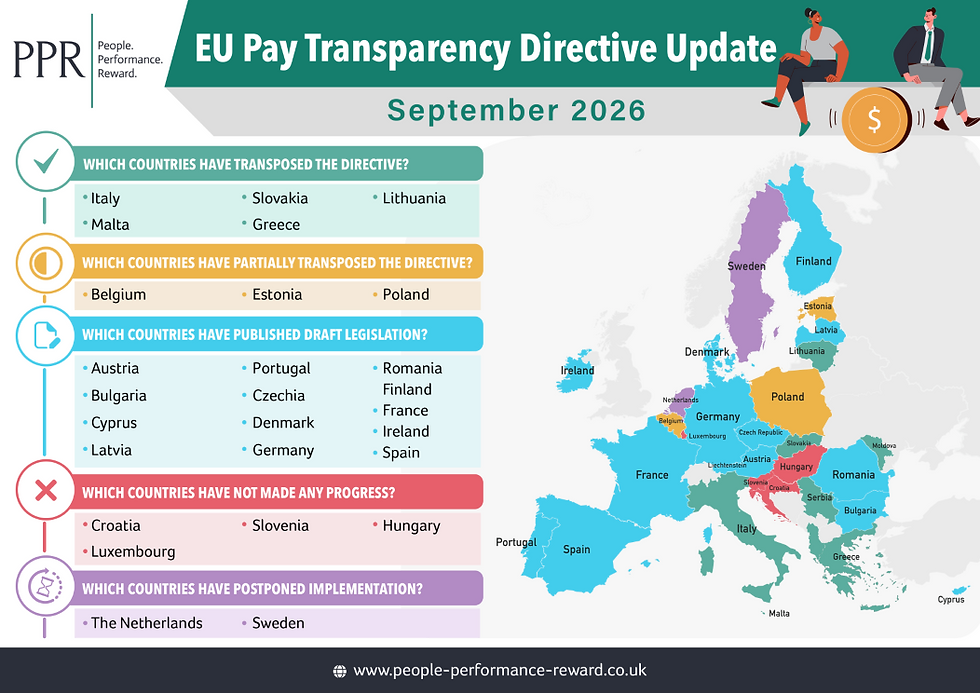
The 7 June 2026 deadline for implementation of the EU Pay Transparency Directive is rapidly approaching. Various EU member states have published draft legislation, but many are yet to announce any legislative progress or clarify expected timelines. Which countries are leading the way and which are falling behind? People. Performance. Reward. considers the implementation status of the EU Pay Transparency Directive below.

Leading / Partial Implementation
Belgium
Belgium has remained the frontrunner, having first transposed elements of the Directive into law in January 2025 As of 26 January 2026, the Belgian Chamber of Representatives has proposed a resolution to reduce the impact of the transposition on organisations, namely by requesting that the federal government avoids over-regulation and limits legislative changes to only what is explicitly required in the Directive.
Malta
Malta has partially transposed the Directive into law, addressing key elements such as recruitment transparency and employee rights to request pay information.
Poland
Poland has also partially transposed the Directive, with some recruitment-related obligations implemented.
Slovakia
Draft legislation has been approved, and the Slovak Parliament is expected to ratify a new Act to Strengthen the Application of the Principle of Equal Pay for Equal Work or Work of Equal Value Between Men and Women imminently.
Draft Legislation / Legislative Progress
The Netherlands
Draft legislation was published in March 2025, however, the collapse of the Dutch government in June 2025 stalled progress. As a result of this, the Dutch government announced in September 2025 that full implementation of the Directive was to be delayed to 1 January 2027, as meeting the original deadline was no longer feasible. This proposed postponement was rejected by the European Commission in December 2025.
An amendment to the previously published draft legislation was submitted in January, but it remains unlikely that the Netherlands will meet the 7 June deadline. Dutch employers caught between the contrasting national and EU timelines for implementation should plan to fulfil the obligations of the Directive by the June deadline, to avoid becoming vulnerable to charges of non-compliance.
Ireland
Ireland is also facing challenges with meeting the 7 June deadline. The Irish Independent observed that only 6% of Irish businesses are prepared to fulfil the obligations outlined in the Directive. Citing delays in receiving finalised guidance and production of a workable national toolkit, the Irish Business and Employers' Confederation have formally requested a one-year postponement. It is likely that any postponement will remain nationally recognised only, rather than formally acknowledged by the EU Commission, presenting Irish employers with similar non-compliance risks as Dutch employers.
However, Ireland already has legislation in place obligating employers of 50 employees or more to undertake gender pay gap reporting, which provides a foundational basis for organisations to adapt accordingly. In addition, the formal amendment to this legislation aiming to bring it in-line with the Directive is included in the Government Legislation Programme for Spring 2026, suggesting progress is forthcoming despite delays.
Cyprus, Lithuania, Sweden, Italy and Finland
Draft legislation has also been published in Cyprus, Lithuania, and Sweden, Italy and Finland but within this group contrasts have arisen.
Cyprus’s draft bill, released in late 2025, sets out a detailed framework for pay transparency and enforcement. Cyprus' proposed amendments do go beyond the minimum, unlike several other countries.
Lithuania has published its draft legislation and continues to develop it toward adoption, while Sweden’s approach is well advanced, with formal amendments to the Discrimination Act under consideration and an expected early‑2026 vote.
Italian government has issued its first draft law implementing the Directive, largely mirroring its provisions but introducing notable additions, including a strong role for collective bargaining in defining work of equal value and a ban on salary history inquiries during recruitment.
Yet to Act / Minimal Progress
Countries with Expected Draft Legislation
Draft legislation is still expected for the Czech Republic, Estonia, France, Germany, Latvia, Romania, Slovenia, and Spain.
Countries with No Publicly Announced Action
No publicly announced action has as yet been taken by Austria, Bulgaria, Croatia, Denmark, Greece, Hungary, Luxembourg, Portugal.
It remains to be seen if more countries will be forced to adopt the phased approach of the Netherlands, or will instead rapidly implement new legislation, causing potential administrative chaos for employers.
If you would like to discuss how the EU Pay Transparency Directive may affect your organisation — including its impact on your reward strategy, pay reporting processes and governance frameworks — please get in touch with our Principal Consultant, Paul Hunter at paul@people-performance-reward.co.uk to explore how we can support you.
Reference List
‘Decree amending the decree of 12 December 2008 relating to the fight against certain forms of discrimination’, Wallonia-Brussels Federation Portal, 16 May 2024
‘Gender Pay Gap Information Act 2021’, Irish Statute Book, 13 July 2021
‘The government approved the law on equal pay for men and women’, Ministry of Labour, Social Affairs and Family, Government of Slovakia, 17 December 2025
‘Government Legislation Programme, Spring 2026’, Department of the Taoiseach, Government of Ireland, 13 January 2026
Gozzi, Laura, ‘Dutch government collapses after far-right leader quits coalition’, BBC News, 3 June 2025
‘Implementation of the wage transparency directive’, Overheid NL, 19 January 2026
O’Donovan, Donal, ‘Irish firms among companies least ready to implement new ‘pay transparency’ rules, survey finds’, Irish Independent, 16 February 2026
‘Pay Transparency deadline in doubt, Ibec calls for postponement’, Industrial Relations News, 19 February 2026
‘Proposed resolution concerning the implementation of the European directive on pay transparency’, Chamber of Representatives of Belgium, 26 January 2026
‘The Strengthening the Implementation of the Principle of Equal Remuneration between Men and Women for Equal Work or Work of Equal Value, through Wage Transparency and Enforcement Mechanisms Law of 2026’, Labour Relations Department, Government of the Republic of Cyprus, 5 November 2025
Yanatma, Servet, ‘Pay transparency in Europe: Which countries are leading or lagging?’, Euronews, 21 October 2025